Oncle Julien
Blood CanticleOncle Julien’s ghost turns the supernatural into a direct personal conflict for Lestat: he appears with startling solidity, mocks Lestat’s attempts to protect Mona, and claims her as his child. Yet Michael’s account of Julien’s failed intervention complicates the image of an all-knowing spirit. Across these encounters, Julien is at once a vivid presence, a family protector whose actions can go disastrously wrong, and a test of Lestat’s certainty about what the dead know and where they can take the living.
Identity and Manifestation
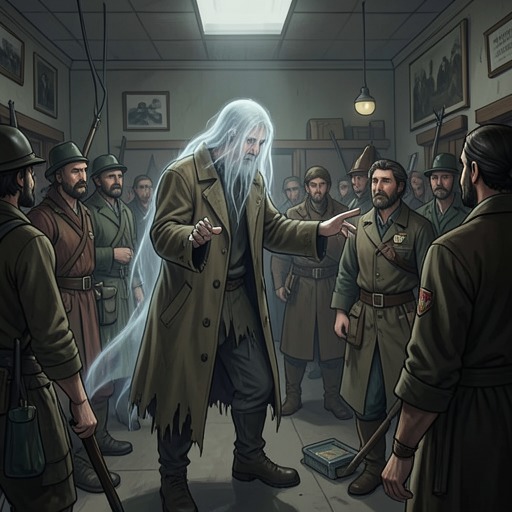
When Lestat encounters Oncle Julien in the crowded double parlor, the ghost is not a vague shadow. He stands in a far corner in a slim gray suit, arms folded, watching Lestat with calculating opposition; Lestat experiences him as fiercely actual and bright. The contrast between Julien’s ordinary, composed appearance and his status as a ghost makes his presence especially disconcerting: the dead man seems physically present even though the other people in the room cannot see him.
Julien’s appearances are not limited to silent observation. When Lestat insists that no one should interfere with a woman who has chosen to die, Julien laughs and asks what Lestat will do. His amusement places him in open opposition to Lestat’s plea and makes the ghost an active participant in the scene rather than a passive apparition.
Claims on Mona and Conflict with Lestat
The conflict becomes explicitly familial when Lestat catches Julien during an apparition. Julien struggles to dissolve from Lestat’s grasp, but Lestat holds him by the throat, attempting to hurt a presence that should be immaterial. Julien answers that he can haunt Lestat and accuses him of taking his child, Mona. His words establish the personal claim underlying his hostility: he sees Lestat’s intervention in Mona’s fate as a theft from him.
Julien says he had been waiting for Mona and reproaches Lestat for not allowing her to come to him. Lestat rejects Julien’s implied authority, demanding to know what kind of afterlife he comes from and where he intended to take Mona. His barrage of questions about a supposed Summerland, supernatural promises, and the destination awaiting her shows that he does not accept the ghost’s claim as proof that Julien can safely guide her. Their confrontation therefore turns on both attachment and the limits of spiritual authority: Julien claims a child, while Lestat challenges the destination and knowledge behind that claim.
Knowledge, Error, and the Dead
Michael offers a crucial counterpoint to Lestat’s suspicion of Julien. He recalls that Julien appeared to him once, apparently in an effort to help, but that the intervention led to a total disaster. Michael insists Julien could not have known what the result would be, and cautions that ghosts do not know everything. The recollection does not explain the disaster, but it makes Julien’s limitations consequential: his interventions may be well-intended and still cause harm.
Rowan’s account of the dead supplies a different boundary. She says that Julien had come to her long ago only in a dream, when he wanted her to do something, whereas the dead people she saw, including her parents, were waiting to take her across but did not speak because it was not yet her time. Her distinction suggests that Julien’s appearances and purposes are particular rather than part of a universally reliable passage between life and death. Together, Rowan’s and Michael’s accounts resist any simple equation of ghostly presence with complete knowledge or unquestionable guidance.
Guilt, Faith, and Narrative Significance
Julien’s presence also bears on Lestat’s struggle to imagine himself as a force for good. Alone in his fantasy of the Sistine Chapel, Lestat yearns to be a priest and to consecrate the host, then recognizes that his imagined sainthood cannot hold. He sees himself instead as a vampire who lives by blood and feels ritually impure. In this moral crisis, Julien’s ghost is one more reminder that Lestat’s actions carry consequences beyond his own intentions, even as Lestat resists the idea that a ghost can absolve or direct him.
After Lestat helps guide Patsy away, he reports that some force may have tried to take him with her because they were connected as she began to rise. He says that he escaped and that Patsy is gone on; another witness recalls him fighting and calling out Julien’s name. The episode does not establish precisely what Julien did there, but his name returns at a moment when Lestat confronts the perilous boundary between the living and the dead. Across the novel’s encounters, Julien remains both an intimate family presence and an uncertain spiritual agent: vivid enough to seize, accuse, and haunt, yet fallible enough that his desire to help cannot guarantee a safe outcome.